

Anyone passionate about American cinema knows the legendary director and actor Woody Allen. While his work is widely recognized, fewer people are familiar with his personal life, character, and relationships. At times, to achieve fame in Hollywood, Allen could be as ruthless as he was romantic—reflecting the very essence of the city he loved and where he was born. Beyond his iconic black-rimmed glasses lies a charisma described as the “feline sexual allure of a jungle cat.” New York City was his playground, but the Bronx was where his journey began. Learn more about this accomplished native New Yorker on bronxski.com.
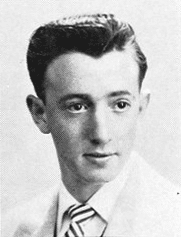
Grandparents and Parents: Role Models or Critics?
Woody Allen’s parents were first-generation Jewish immigrants in New York City. His mother, Nettie Cherry, was born in 1908, shortly after her father, Leon, left Austria at the age of 26 to seek fortune in America. Leon married Sarah Hoff, another Austrian immigrant, and initially lived in Manhattan’s Lower East Side. By 1908, Leon had saved enough to open a small store selling food, candy, and various goods. This business later grew into a chain. By 1920, the family moved to the Bronx.
Leon remained an orthodox Jew throughout his life, speaking mainly Yiddish, knowing only a few words of English, and observing strict religious practices like lighting Sabbath candles every Friday evening. He instilled a strong work ethic in his children but showed little interest in higher education or the arts, dedicating his life to work.
Nettie inherited her father’s industriousness and worked tirelessly. Allen later described her routine as mundane yet relentless. She studied accounting and worked for a company specializing in butter, poultry, and eggs. During her commute one day, she noticed Isaac Konigsberg, a middle-aged mustachioed butter and egg salesman. Isaac, a lover of custom-tailored suits and classical music, introduced her to his son Marty. Though not conventionally handsome, Marty’s humor and charisma won Nettie over. The couple married in 1930, though their relationship was fraught with challenges. Marty struggled to hold down a job, indulged in costly suits, and often quarreled with Nettie. Despite their differences, Nettie became pregnant in 1935, and the couple relocated to the Bronx’s Mount Eden Hospital to welcome their first child.
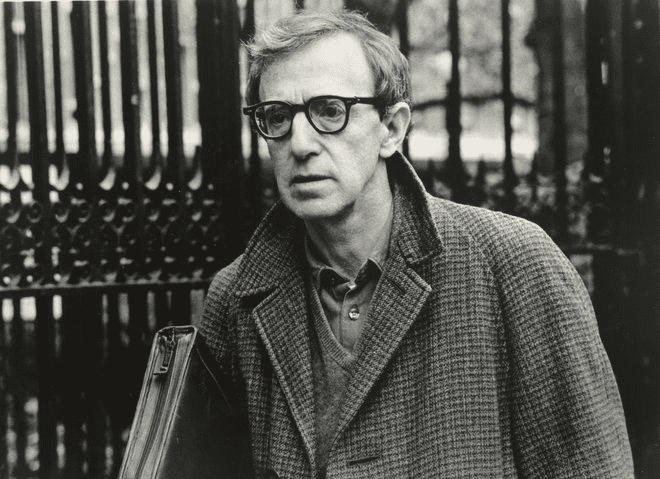
Allan Stewart Konigsberg (Woody Allen) as a Child
Woody Allen was born on Sunday, December 1, 1935, with red hair, large ears, and fair skin resembling his mother. His arrival deepened the tensions between his parents, who argued frequently. Nettie found work as an accountant for a florist, leaving Woody in the care of hired nannies. These caregivers, uninterested in early childhood development, prioritized gossip and wages over his well-being. Woody later recounted near-fatal incidents, like one nanny accidentally smothering him with a blanket.
When Nettie returned home from work, she had little time for nurturing. Allen described his childhood as emotionally strained, with his mother often resorting to yelling or physical discipline. Despite this, Woody developed a remarkable ability to suppress his emotions. He learned early on the difference between good and evil, forming a complex understanding of human behavior.
Allen later exacted subtle revenge on his parents through humor. In his comedic routines, he joked about his mother’s bizarre advice, such as placing him in bed with a live bear or encouraging him to trust strangers offering candy. In 1986, he attempted to create a documentary titled Two Mothers to explore his strained relationship with Nettie, but the project was never completed.

Education
Growing up in New York City, Woody first attended Hebrew School before enrolling at Midwood High School in Brooklyn, where he earned the nickname “Red” due to his hair.
Allen later attended New York University, City College of New York, and the private New School, but was expelled from each institution for lack of interest in their curricula. Around this time, he adopted the name Woody after jazz musician Woody Herman.
The Start of His Comedy Career
As a student at New York University, Allen began crafting jokes, eventually monetizing his humor. He gained recognition by performing in clubs, writing a humor column for The New Yorker, and scripting for television shows and other comedians.
Literature, Theater, and Music
Over his lifetime, Woody Allen authored and published four collections of plays and stories: Getting Even (1971), Without Feathers (1975), Side Effects (1980), and Mere Anarchy (2007).
Allen’s theatrical debut came in 1966 with Don’t Drink the Water, a play that cemented his reputation as a playwright. The production ran 598 performances. His subsequent play, Play It Again, Sam, ran for 453 performances. Throughout the 1970s, he presented works such as God and Death, followed by The Floating Light Bulb (1981), Central Park West (1995), and Bullets Over Broadway in the 2000s.
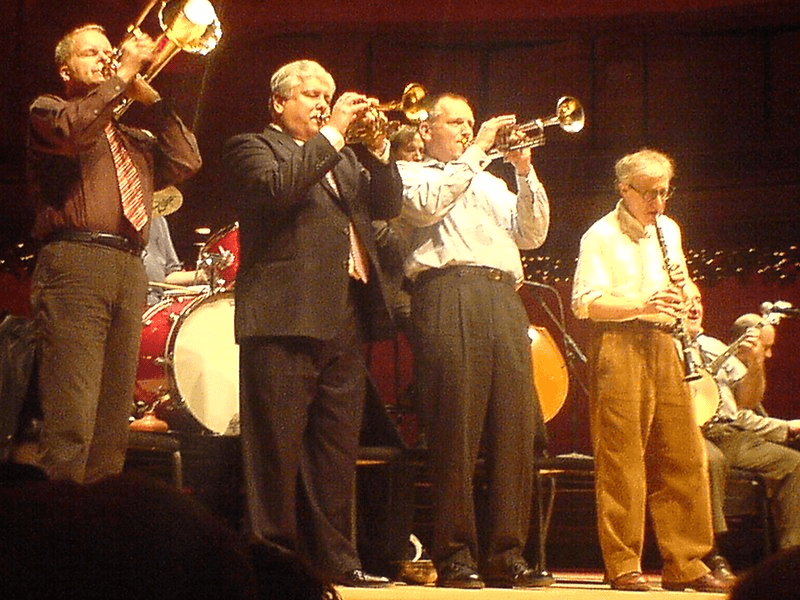
Allen’s love for classical and jazz music, possibly inherited from his grandfather, inspired him to perform as a clarinetist in jazz clubs. He formed his own jazz band, which performed weekly at Manhattan’s Carlyle Hotel.
Cinema
Woody Allen achieved his greatest success in film. His early comedies were celebrated for their wit, while his later, more serious films were poignant and thought-provoking. His most iconic works include Manhattan, Annie Hall, and Hannah and Her Sisters. Starting in the 1970s, Allen released at least one film per year, consistently drawing audiences despite mixed critical reviews. Over his career, he wrote and appeared in more than 80 films.
Legacy of a Bronx-Born Icon
Woody Allen’s family emigrated from Austria, enduring hardships before establishing a stable life in America. They provided him with opportunities that, combined with his talent and passion for cinema, led to his success as a renowned filmmaker, writer, and actor.